Contrada Inferno
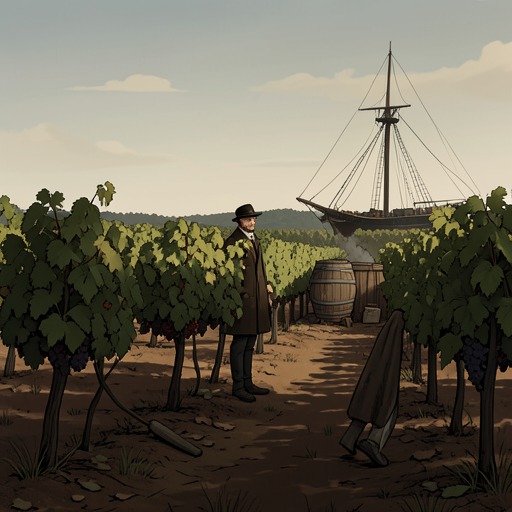
The Florios of SicilyContrada Inferno is the site of Vincenzo Florio’s planned Marsala wine cellar, chosen for the way its coastal position could link production directly to shipping. The place matters not simply as a setting but as a business decision: its natural terrain and proximity to other wineries shape the cellar’s location, design, and role in a trade built around moving wine efficiently to market.
Location and Commercial Logic
Vincenzo’s choice emerges from a comparison of the Marsala coast with the sulfur quarry shown on the map Raffaele brings to the office. The coast’s direct sea access is decisive. Roads in the area amount to little more than sheep tracks, and large wagons cannot pass; transporting barrels overland would require spending money on carts and small conveyances. Vincenzo instead wants the barrels to travel from the production works straight to the ships’ holds. The site is selected to make geography serve the business rather than force the business to accommodate bad roads.
Raffaele identifies the land as being in Contrada Inferno: two tummini behind a natural hill, offered for sixty oncie, with an additional tax payable to Baron Spanò. Vincenzo orders the purchase secured immediately and is prepared to provide an advance. His urgency reflects both the growing interest in Marsala wine and his expectation that land prices will rise as the opportunity becomes more widely recognized. The location is therefore an investment as well as a practical solution to transport.
Construction and Design
When Vincenzo later inspects the developing works, the landscape is exposed to strong coastal weather. The tramontana sweeps along the seafront, the Aegadian Islands stand opposite the Marsala coast, and salt spray marks the carriage windows. Against this setting, workers build walls on scaffolding that shakes in the wind. The cellar is conceived not as an ordinary country house or farm, but as a factory modeled on British examples, with a large central courtyard and warehouses arranged around it.
The site is still under construction when Vincenzo arrives: bricks, tiles, timber, beams, rocks, and builders mixing mortar crowd the route. A main house is being prepared for the factory administrator, while carpenters install supports for the wine-refinement casks in one of the two side buildings. Vincenzo gestures for the workers to continue and walks through the hall, whose high ceiling is punctuated by tuff arches and whose portals and dormer windows admit abundant light. He identifies this hall as the cellar’s heart. The buildings give the selected site an industrial organization, bringing administration, storage, and wine processing together in a planned complex.
Production and Trade
The cellar’s intended function is tied to an active effort to secure grapes and must. Raffaele reports that purchasing the harvest has gone better than expected, although Woodhouse and Ingham have already acquired a large share. He has obtained ansonica, grillo, and damaschino must in Alcamo, as well as catarratto, and says that wine already fermented will be transferred to the cellar the following week. Contrada Inferno is thus not an abstract future project: it is being prepared to receive materials already gathered through regional purchasing.
The direct route from cellar to ship connects the local site to a wider trade. Earlier descriptions of spice commerce in the novel establish a pattern in which goods pass through many hands and across long routes before reaching buyers; the Marsala venture presents a different but related commercial problem, in which transport costs and control of distribution affect the value of production. Here, the chosen coastal position is intended to reduce reliance on inadequate roads and move barrels from the plants to maritime transport. The design of Contrada Inferno makes access, processing, and dispatch parts of one commercial plan.
Narrative Significance
Contrada Inferno shows Vincenzo turning an opportunity into infrastructure. He reads the map in terms of the route a barrel must take, weighs purchase price and tax against the prospect of rising land values, and envisions a factory suited to the work rather than a conventional rural residence. The cellar’s emerging buildings, its supply of must, and its intended access to ships all express the same practical ambition: to organize production around the conditions of the site.
The coast is both an advantage and a constraint. It offers the maritime access Vincenzo needs, while wind, salt spray, and poor roads make the environment a force that shapes construction and commerce. Contrada Inferno consequently stands at the meeting point of land, labor, and sea: a specific parcel selected to connect regional harvests with a larger market through the planned movement of wine by ship.